“Privacy wallets are just for paranoia” — why that misconception misses the point, and what Cake Wallet actually offers
Many people who care about cryptocurrency privacy assume wallets that advertise privacy features are niche tools for experts or for hiding illicit activity. That’s a misleading frame. Privacy in crypto is primarily about reducing unnecessary metadata leakage, limiting attacker learning, and preserving economic confidentiality — practical goals relevant to journalists, dissidents, small businesses, and everyday US users who value financial sovereignty. Cake Wallet is positioned as a multi-currency privacy-first wallet that stitches together several technical defenses into a usable package; understanding how those pieces fit — and where they fail — is the key to deciding whether it belongs in your toolkit.
The short version: Cake Wallet is non-custodial and open-source, supports Monero, Bitcoin, Litecoin (with MWEB), Zcash, and many other chains, and layers device-level encryption, network anonymity (Tor/I2P), hardware-wallet support, and in-wallet privacy tools. Those controls materially reduce attack surface compared with naive wallets, but they are not a silver bullet: privacy is layered and contextual, and wallet choices interact with user behavior, counterparty practices, and the surrounding infrastructure. Below I explain the mechanisms, compare trade-offs with 2–3 reasonable alternatives, surface limits you must know, and give decision heuristics you can reuse.
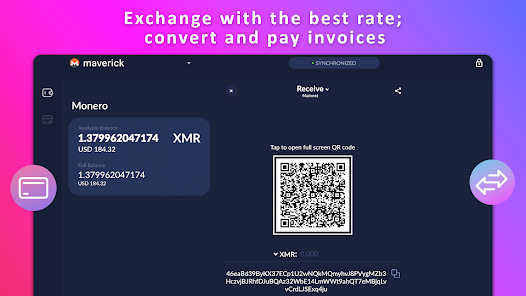
How Cake Wallet’s privacy architecture actually works — mechanism, not marketing
Start with the basics: Cake Wallet is non-custodial and open-source. Non-custodial means private keys remain under user control; the developers do not hold keys or user funds. Open-source means the code that enforces those behaviors is inspectable, reducing the risk of hidden telemetry or secret backdoors. These two facts establish a floor: attacks that require server-side key access are infeasible unless the user runs compromised software or their device is breached.
On-device protections are the next layer. Cake Wallet leverages device-level hardware security — Secure Enclave on iOS or TPM on Android — to encrypt wallet data and protect keys. Local access is gated by a short PIN or biometrics. Mechanistically this reduces the risk of key extraction from a stolen device, but it depends on the device OS and supply-chain security: an attacker with high-level access to an already-compromised phone can still exfiltrate keys if they bypass or exploit the OS.
Network anonymity is deliberately multi-pronged. Cake Wallet supports Tor-only operation, optional I2P, and custom node configuration. That matters because blockchain transactions carry network metadata: IP addresses and timing information can be correlated with on-chain behavior to deanonymize users. Running through Tor or I2P reduces that link, but it depends on correctly configured routing and endpoint behavior (for instance, whether you connect to a remote node you trust). Using custom nodes further shifts trust away from public infrastructure but requires the user to operate or vet those nodes.
Coin-level privacy varies by asset and uses different mechanisms. For Monero, privacy is inherent to the protocol (ring signatures, confidential amounts, stealth addresses) and Cake Wallet preserves key privacy by keeping the private view key on-device and supporting subaddresses for transaction separation. For Bitcoin, Cake Wallet includes modern privacy tooling — Silent Payments, PayJoin v2, UTXO coin control, and batching — which are pragmatic measures that reduce linkability on a transparent chain. For Litecoin, the wallet supports MWEB, which is an optional MimbleWimble layer that obscures amounts and improves unlinkability for transactions that opt in. For Zcash, Cake Wallet enforces mandatory shielding of outgoing funds, ensuring users do not accidentally leak funds from shielded to transparent pools.
Where Cake Wallet shines and where trade-offs matter
Strengths
– Breadth of protocol support. Managing XMR, BTC, LTC (with MWEB), ZEC, ETH, SOL and others in a single interface is useful if you actively hold multiple assets and want consistent privacy posture across them.
– Network privacy options. Built-in Tor and I2P support with custom-node selection gives users real choices about how much network-level exposure they accept.
– Hardware-wallet integration. Support for Ledger and Cake’s air-gapped Cupcake lets users escalate security by moving signing out of the general-purpose device — a powerful defense against device compromise.
– Zero telemetry and open-source stance. A strict no-data-collection policy materially lowers the likelihood of developer-side data leaks; open-source code lets third parties verify those claims.
Trade-offs and limits
– Usability vs. safety. Privacy features require user choices (selecting Tor mode, coin control, subaddress management, or MWEB activation). Mistakes like reusing addresses, connecting to untrusted nodes, or poor seed storage can erode protections faster than the wallet’s built-in defenses can recover.
– Protocol-specific limits. Monero provides stronger default privacy than Bitcoin because of protocol design. Bitcoin privacy tools (PayJoin, coin control) help but cannot make BTC behave like a privacy coin; transaction graph analysis and exchange KYC practices can still reveal links. MWEB on Litecoin is optional; most LTC on the network remains transparent unless users opt in.
– Migration edge cases. The wallet cannot transparently solve all migration scenarios; a documented example is Zcash migration from some Zashi wallets: seed incompatibilities require manual fund transfers. That shows even robust wallets encounter protocol-ecosystem friction.
– Device compromise and supply chain. Device-level encryption protects against casual theft but not against firmware-level attacks or physical extraction in adversarial settings. Hardware wallets reduce but do not eliminate these risks — their security depends on correct setup and supply-chain integrity.
How Cake Wallet compares with two common alternatives
Alternative A — a mainstream custodial exchange wallet (e.g., exchange hot wallet): Convenience is high and on-ramps are simple, but privacy is minimal. Exchanges log IPs, KYC data, and transaction histories. Mechanistically, custody places keys and transaction metadata under third-party control, which is incompatible with privacy goals. Choose custodial if you prioritize convenience and regulated services, but not if privacy is a priority.
Alternative B — specialized hardware+node stack (e.g., a full-node Bitcoin setup + hardware signer): This configuration maximizes privacy and sovereignty because you control the node and signing environment. The trade-off is complexity and cost: running nodes, maintaining hardware wallets, and managing backups requires time and technical skill. Cake Wallet with Ledger/Cupcake integration sits in the middle: it gives much of the hardware separation without the full-node maintenance burden, though running an independent node is still the gold-standard if adversary models demand it.
Where Cake Wallet fits: users who want a strong but pragmatic privacy posture across multiple coins, prefer software convenience, and are willing to manage a few operational choices (use Tor, enable coin control, use hardware signer for large holdings). It is less suitable for users whose threat model requires full-node isolation, air-gapped supply-chain guarantees, or legal/financial workflows that demand custodial auditing.
Practical heuristics: three decision-useful rules for US users
1) Threat model first, convenience second. Map who you worry about — casual surveillance, sophisticated investigators, or state actors — and pick features accordingly. Use Tor/I2P and subaddresses for journalist-level threats; add hardware signing and private nodes for stronger adversaries.
2) Treat each coin according to its protocol properties. Don’t expect Bitcoin tools to replicate Monero-level privacy; instead, use coin control, PayJoin, and batching for BTC and MWEB for LTC when you need extra confidentiality.
3) Protect seed and device supply chain. A wallet’s software guarantees are only as good as the seed backup and device integrity. Use a hardware wallet for significant balances, maintain offline backups, and verify firmware sources.
What to watch next — conditional signals and near-term implications
Several structural trends will affect the utility of privacy wallets. First, regulatory scrutiny in the US and globally could make privacy tools politically sensitive; this does not change cryptographic realities but may lead to service-level friction (exchanges limiting shielded-coin withdrawals, for example). Second, adoption of MWEB-like privacy extensions in larger networks (if they gain liquidity and tooling) will change the trade-offs for transparent chains. Third, improvements in wallet UX for privacy (automated PayJoin/PayJoin v2, better subaddress management) are the most practical lever to increase everyday privacy without requiring users to be protocol experts.
These are conditional scenarios: stronger regulation would increase friction but not eliminate privacy technology; wider MWEB adoption could make Litecoin more private in practice, but it requires counterparty acceptance; better UX will help, but only if default settings favor privacy rather than convenience.
FAQ
Is Cake Wallet truly non-custodial and private?
Yes: Cake Wallet is designed as a non-custodial, open-source wallet and enforces a zero-data-collection policy. That combination means developers do not hold private keys or collect telemetry. However, true privacy depends on how you configure network routing (Tor/I2P), whether you use hardware signing, and how you manage seed backups and address reuse.
Which coin should I use in Cake Wallet if I want the strongest default privacy?
Monero provides the strongest default privacy because of its protocol-level designs (ring signatures, stealth addresses, confidential amounts). Cake Wallet preserves those properties by keeping view keys on-device and supporting subaddresses. For Bitcoin and Litecoin, privacy requires active use of tools (PayJoin, coin control, or MWEB), and results will be conditional on counterparties and network practices.
How does Cake Wallet protect network-level anonymity?
It offers Tor-only mode, I2P proxy support, and the ability to connect to custom nodes. That reduces IP-to-transaction linking, a common deanonymization vector. But remember: using Tor correctly, selecting trusted nodes, and avoiding address reuse are essential to realize those protections.
Should I use the built-in swap features for privacy-sensitive trades?
Built-in swaps via NEAR Intents automate decentralized routing through multiple market makers, which can reduce reliance on centralized exchanges. This can be privacy-improving compared with moving funds on and off KYC exchanges, but swaps still involve counterparties and liquidity providers; for high-threat scenarios, consider splitting trades or using hardware signing and trusted counterparties.
Where can I get the wallet?
If you want to evaluate the software yourself, you can find the official link for downloads here: cake wallet download. Always verify checksums and source authenticity, and prefer official app stores or the project’s verified releases.
Conclusion: privacy wallets are not about hiding wrongdoing; they are about limiting accidental exposure and preserving meaningful control over financial metadata. Cake Wallet presents a thoughtful, pragmatic stack — open-source, multi-protocol, hardware-compatible, and network-aware — that reduces several common privacy failures. It is not an automatic cure: users must understand protocol differences, configure protections thoughtfully, and manage device and seed hygiene. If you adopt Cake Wallet, treat it as one important layer in a broader operational security practice rather than a single-line defense.
Share on Facebook Share on Twitter Share on Pinterest
0 Comments on "“Privacy wallets are just for paranoia” — why that misconception misses the point, and what Cake Wallet actually offers"